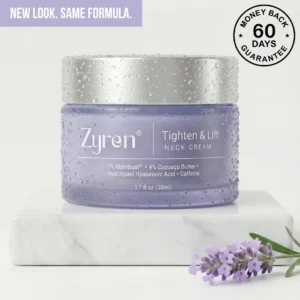
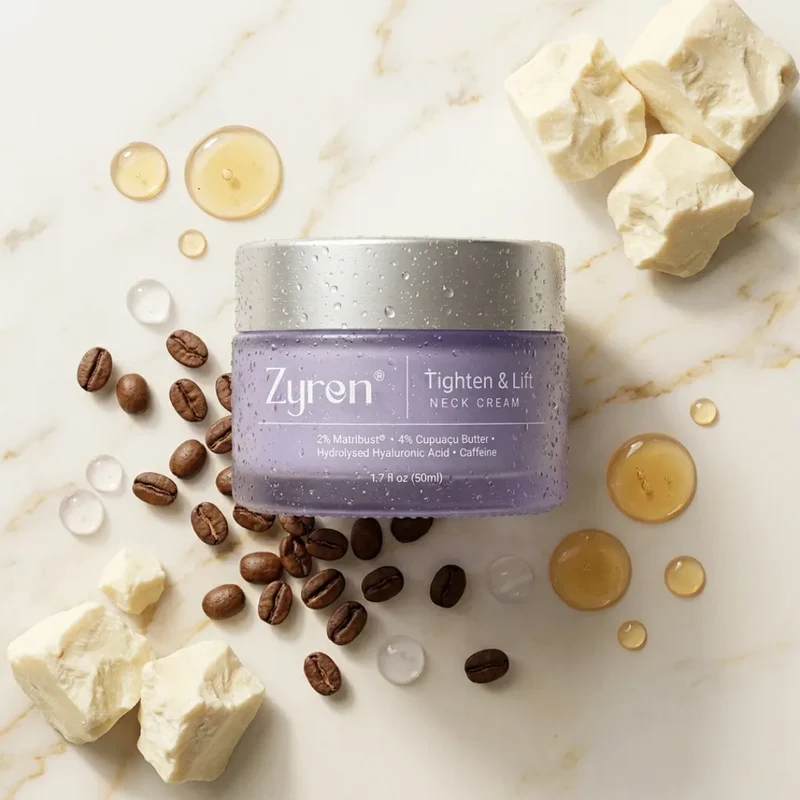
Zyren® Tighten & Lift Neck Cream
This one is more interesting than the first two, because it’s better disguised. Same category of aggressive DTC marketing, but the tells are subtler and the product itself is less absurd. Let me walk through it.
What’s actually reasonable here:
- The full INCI list is disclosed, which is a real transparency positive that the first two products didn’t do as cleanly.
- The ingredient list is a plausible moisturizer: aloe, plant butters, olive-derived emollients, jojoba oil, hydrolyzed hyaluronic acid, glycerin, caffeine, vitamin E, various botanical extracts, standard preservatives (potassium sorbate, sodium benzoate, 1,2-hexanediol, caprylyl glycol). Nothing alarming, nothing exotic.
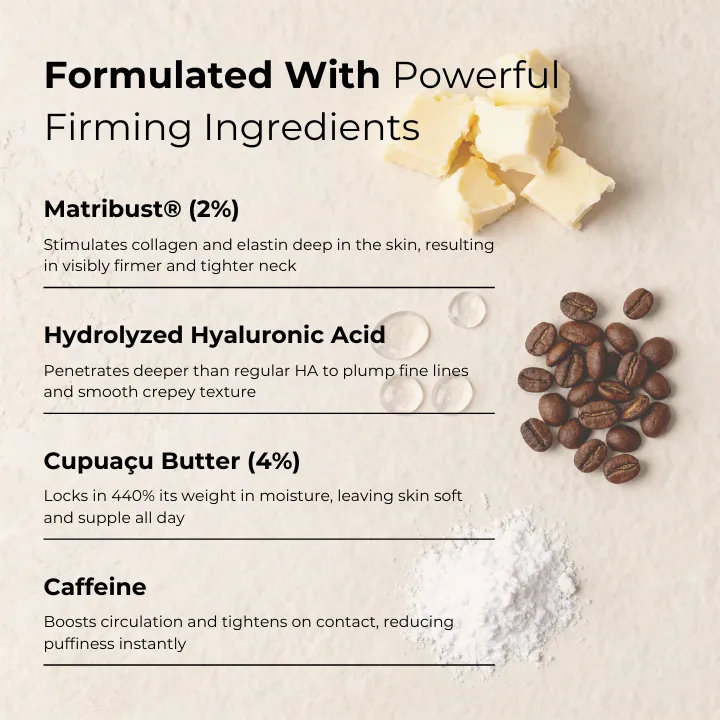
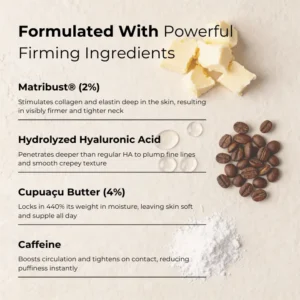
- Cupuaçu butter (Theobroma grandiflorum) is a real, well-regarded emollient. It doesn’t literally “hold 440% of its weight in water” the way the copy suggests, but it is genuinely moisturizing.
- The claimed timeline (weeks to see softening of texture) is at least in the right order of magnitude for a moisturizer — unlike the scar gel’s “7 days” or the eyeliner’s fantasy origin story.
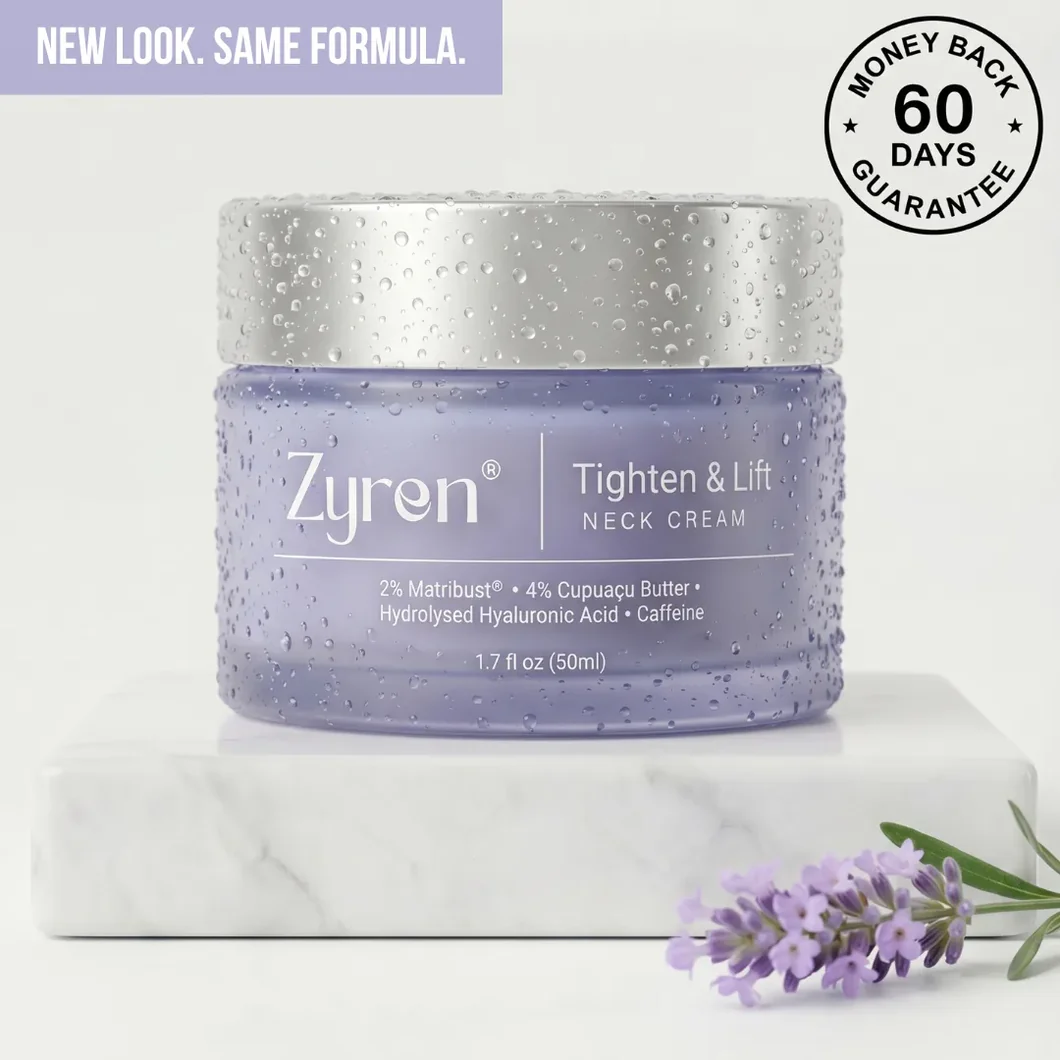
- 60-day money-back guarantee is a real consumer protection if honored.
Where it slides into the same playbook:
- “2% Matribust® peptide complex” — the ® suggests a proprietary trademarked ingredient, but I can’t find “Matribust” in the actual INCI list you provided. Peptides in cosmetics have INCI names (palmitoyl tripeptide-1, acetyl hexapeptide-8, etc.). The only peptide-adjacent ingredient I see is palmitoyl carnitine, which is not a collagen peptide — it’s a fatty acid derivative. If “Matribust” were a real peptide complex at 2%, its components should appear high in the ingredient list. They don’t. This looks like a made-up brand name attached to nothing verifiable.
- “6% active ingredients (60x more!)” vs the “luxury neck cream” comparison — the 60x figure is meaningless without defining “active.” Any brand can classify ingredients as active or not to make their number look big.
- “Peperonyl Glucose” in the INCI list — this doesn’t appear to be a recognized cosmetic ingredient name. It may be a typo (perhaps meant to be a glucoside of something), but a real INCI list shouldn’t contain unrecognizable ingredients.
- The stat block (93%/96%/97%) is footnoted as “internal studies and customer feedback surveys” — meaning survey responses, not clinical measurement. That’s disclosed, which is better than the other two products, but the numbers are still presented as if they were clinical outcomes.
- “Clinically Tested” as a headline, then a footnote clarifying it’s survey data — the headline and the footnote don’t match.
- “Zero irritation reported in clinical testing” contradicts their own review summary lower on the page, which mentions “one experienced a skin reaction.”
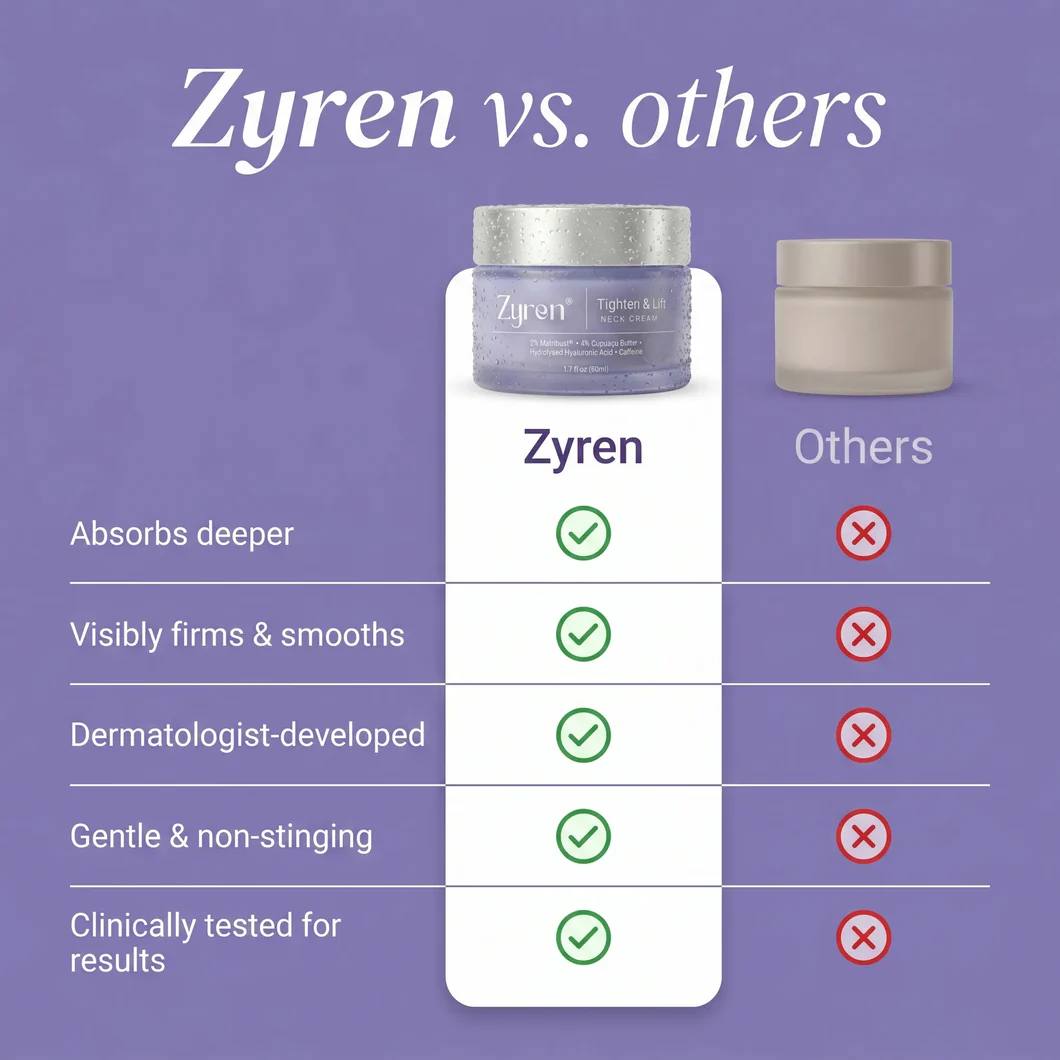
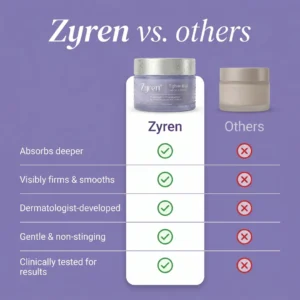
- The “Zyren vs Luxury Neck Cream” comparison table — comparing against an unnamed generic villain (“Basic Moisturizing,” “Contains Toxins,” “No Results”) is a rhetorical device, not information. No real competitor is named because no specific comparison was actually made.
- Reviews are all short, all first-name-plus-age, all glowing, all from women 55–71. The demographic targeting is precise. “Verified by Shop” means verified by Shopify’s Shop app (i.e., someone bought it through that checkout) — it doesn’t verify the review’s authenticity or that the reviewer isn’t incentivized.
- “Red light therapy device” upsell framed as a pro tip — standard funnel expansion.
The bigger picture:
Zyren is likely a decent-enough moisturizer sold at a large markup with invented pseudo-science on top. £24.73 for a jar of what the ingredient list describes — a plant-oil-and-glycerin emulsion with hyaluronic acid, caffeine, and botanical extracts — is on the high side but not outrageous. The problem isn’t that it will harm you or do nothing; it’s that the specific claims driving the purchase (firming, tightening, density improvement, collagen boosting, “Matribust” doing anything measurable) aren’t supported by anything in the actual formula or the actual data.
The honest version of what this product is: a well-formulated moisturizer that will make neck skin look softer and more hydrated for as long as you use it, and revert once you stop. That’s true of most moisturizers. Nothing topical — this or otherwise — meaningfully reverses sagging or restores dermal density; that’s the domain of procedures (ultrasound, radiofrequency, surgical lift) with real trade-offs. A cream that genuinely did what this one claims would be a prescription drug, not a £25 jar sold on Shopify.
Ranking the three you’ve shown me:
- Zyren — overhyped but the underlying product is real and the ingredient list is legitimate. Overpriced for what it is; the marketing claims are inflated but the product itself won’t harm anyone.
- Luxevéria eyeliner — the product itself (an MQ-resin liner) is a real, functional category. The marketing is heavy fabrication, but if you got the tube it’d probably work like other long-wear liners.
- Luxevéria ReGenScar — the most misleading. Called a “stem cell” product with no stem cells, makes medical claims about keloids and old scars that aren’t remotely supported, and prices a basic silicone-and-onion-extract formula at a premium.
Are you looking at these because you’re considering buying one, or is there something else going on — market research, writing about scam marketing, warning someone in your life? Happy to be more targeted if I know the goal.
| Bundle & Save | Buy 1, Buy 2, Buy 3 |
|---|